Workout 10

Workout 2

2 km in 30 min. (Treadmill)

Due to my procrastination and lack of planning, I did not do the other workouts even though I had a whole week to do it. Woops!

Questions

  1. I should start making a routine to keep me from doing nothing productive or not exercising. A routine could also organize my leisure vs. productive time. I could also start exploring other hobbies other than gaming and watching YouTube as it does not really help with education.
  2. One thing I can stop doing right now is not doing the workout given. Exercise is important especially during this lockdown. I do not move as often now I dont go to college everyday. Most of the calories I burn everyday is in my commute to Vanier and getting to my classes.
  3. I must continue with my daily treadmill to keep myself active during the quarantine. Exercising is a way to take myself off a computer screen as it is all I do, since my classes are online and most of my work is on the computer. It helps with eye fatigue and also keeps me physically active.
  4. The most shocking to me in this times of the pandemic is how much staying at home and keeping yourself busy. During the first week of the quarantine, I thought that I would be more productive since I have most control on what I will do but I find myself doing nothing productive. It really challenges your organization skills and making yourself busy.

Workout 9

Workout 2 – Running

**My phone’s camera broke after my phone dropped and shattered (front glass).**
The treadmill is on the first preset. It is a 30 min preset where I jog for 5 min. then walk for 1 min in 5 cycles (to make 30 min).

Workout (everyday)

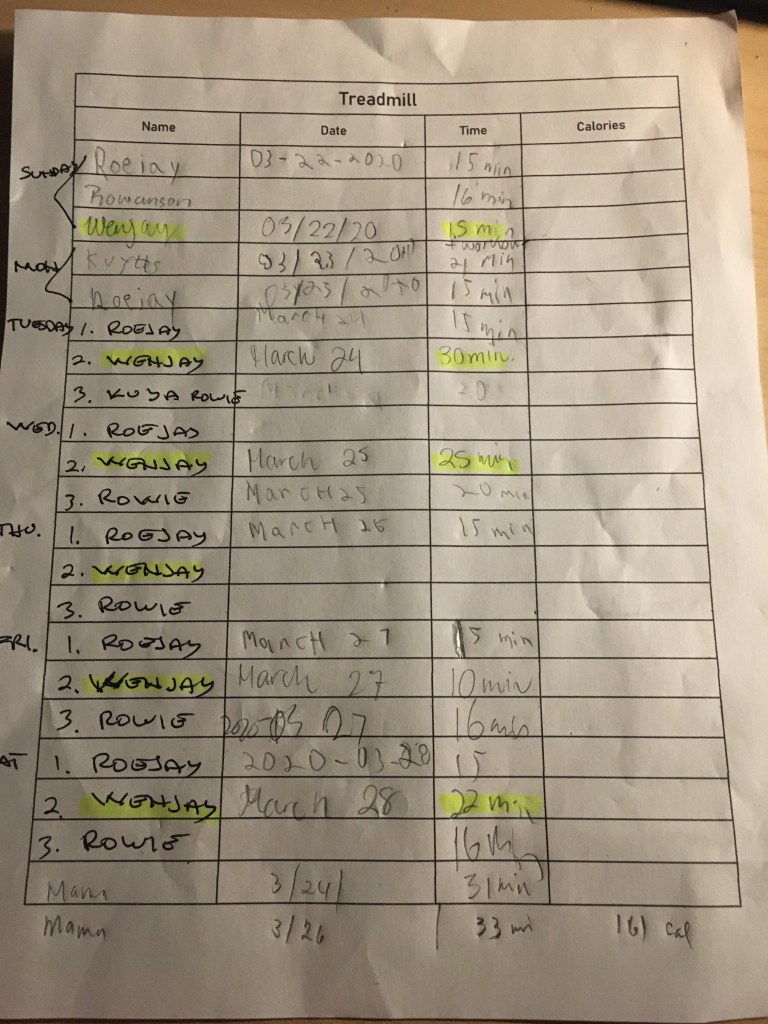
Since the gym closed due to the quarantine, my dad and I decided to make a treadmill schedule/log to keep ourselves active during this time. We are obligated to run on the treadmill everyday and we have to “punch in” our time and date. I am still on the 1st preset on the treadmill but I am planning to go up a preset every week. The only problem is I can not run since there are people on the floor below and their chandelier might fall! However, I am planning, when we clear the backyard, to do most of my workouts outside for more intense workout. I am also watching out for my diet since I am at home 24/7. This means more fruits, vegetables and less carbs (rice, since I am asian).

SMART

Body Composition Readings: Below Average – Poor (Overweight)

Muscular Strength: Average

10 push-ups max, 53 sit-ups (1 min), 1 min plank, 1.5 wallsit

Cardiovascular Endurance: Poor

9 laps in 12 min.

Flexibility: Average

Week 7

Questions:

  1. The point of doing a warm up is to get the blood flowing through your muscles, increase your body temperature and heart rate so you can be prepared on doing harder exercices.
  2. A successful warm up should include stretching so your muscles can stretch during your exercise. It must include some sort of cardio, so you are prepared on doing a much more intense workout that might need a ready heart.
  3. The point of cooling down is to slowly get back to your normal state. Your heart will be pumping fast during an exercise and if you stop abruptly, you might damage it just like your muscles.
  4. The best time to stretch is in the morning when you wake up and before an exercise. Stretching lets you move freely throughout the day and your workout and it prevents from hurting yourself if you overextend yourself.
  5. The optimal duration of your sleep should be around 7 to 9 hours. I sleep around 5 to 7 hours. However, I force myself to sleep at 10 and abandon all homework so I could be ready and stay focus the next day. I’d continue homework when I wake up around 5 or 6 o’clock. I hope that I could start my day by a little workout. However, I always start my day with a phone on my hand so I usually skip on my workout. The best way to ensure I have enough to sleep is to charge my phone in another room as it keeps me up at night.
  6. Health related problems of insufficient sleep are high blood pressure, diabetes, heart attack, heart failure or even a stroke.
  7. You can eat an apple or any other fruit or vegetable when studying.
  8. I can keep a log of my weight each week and see if I am slowly losing weight. It gives me motivation to see that I am slowly making progress than no progress at all.
  9. I see myself being more happy and more confident. I might be more motivated to do more activities other than playing games or watching YouTube videos all day. Being sedentary, especially during this pandemic, have negative effects such as gaining weight, being more lazy and getting weaker (since no exercise).
  10. Healthy Fats: Omega Fats (Avocado, Fish, certain nuts etc.)

Workout:

Week 1

Inspirational video

Workout of the week

Week 1: Plank (1:35 min)

Inspirational quote

It does not matter how slowly you go as long as you do not stop.

Confucius

Fitness Goals

I wish to lose some weight, manage my eating habits and go to the gym more often by the end of this semester, as I would look in better shape and be in better shape. I have gone to the gym for the past years but I have stopped after I started my first semester in CEGEP. Therefore, I will have to plan when I will have to go to the gym. I must find time to excercise and study as well. Like before, I can measure my progress by logging in my workout every time I go and my weight each week. As for nutrition, I will have to be careful of what I eat and consume smaller portions. With all of these methods, I might be able to reach my goal: losing some weight.

Introduce Yourself (Example Post)

This is an example post, originally published as part of Blogging University. Enroll in one of our ten programs, and start your blog right.

You’re going to publish a post today. Don’t worry about how your blog looks. Don’t worry if you haven’t given it a name yet, or you’re feeling overwhelmed. Just click the “New Post” button, and tell us why you’re here.

Why do this?

  • Because it gives new readers context. What are you about? Why should they read your blog?
  • Because it will help you focus you own ideas about your blog and what you’d like to do with it.

The post can be short or long, a personal intro to your life or a bloggy mission statement, a manifesto for the future or a simple outline of your the types of things you hope to publish.

To help you get started, here are a few questions:

  • Why are you blogging publicly, rather than keeping a personal journal?
  • What topics do you think you’ll write about?
  • Who would you love to connect with via your blog?
  • If you blog successfully throughout the next year, what would you hope to have accomplished?

You’re not locked into any of this; one of the wonderful things about blogs is how they constantly evolve as we learn, grow, and interact with one another — but it’s good to know where and why you started, and articulating your goals may just give you a few other post ideas.

Can’t think how to get started? Just write the first thing that pops into your head. Anne Lamott, author of a book on writing we love, says that you need to give yourself permission to write a “crappy first draft”. Anne makes a great point — just start writing, and worry about editing it later.

When you’re ready to publish, give your post three to five tags that describe your blog’s focus — writing, photography, fiction, parenting, food, cars, movies, sports, whatever. These tags will help others who care about your topics find you in the Reader. Make sure one of the tags is “zerotohero,” so other new bloggers can find you, too.